



.jpeg)

The race is on
Software is dead, apparently. At least, that's what the market seems to think.
“I’m an AI company,” said the SaaS company.
Software is dead, apparently. At least, that's what the market seems to think.

At the peak in 2021, many high-quality public software companies routinely traded at 25x forward revenue multiples. Today, 70% of the SaaS universe is valued at less than 5x NTM revenue:
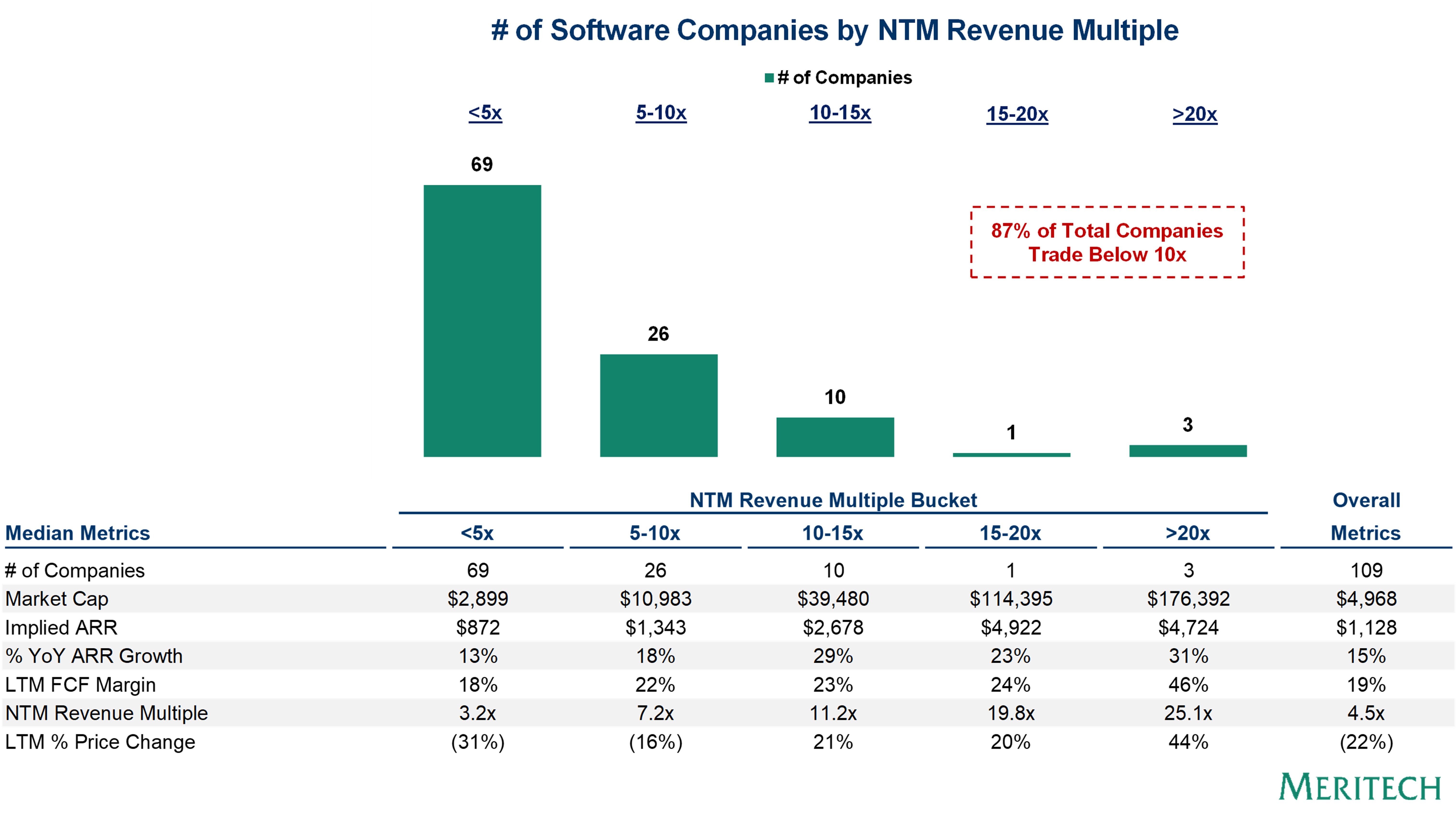
Stalwarts like Atlassian, HubSpot, and Adobe are worth about half of what they were this time last year, despite decades of exceptional execution.
The question being fiercely debated with each stock trade is whether "SaaS" companies are relevant in the age of "AI" companies.
But that is completely the wrong question to ask.
Vibe losing
Let's start with where the winners won't come from: vibe coding custom solutions.
The human ego has driven large companies to create their own software since the start of computing, and that has been a very bad idea. Our big four banks proudly say they spend billions on technology each year, but that is only because they are trapped on custom code and environments, begging the 83-year-old Fortran developer not to retire because they are the only ones who know the black arts of the system. Your online banking app is probably still calling a mainframe right now.
While AI will be completely transformative for software development, there is always a reptilian urge that a new technology must completely and violently kill what came before. In reality, the new technology makes something so cheap and abundant that there ends up being 100x more of it — and in this case, I'm wagering there will be 100x more software developers and vastly more software created for more and more specific niches.
We have seen this movie before. The shift to cloud didn't eliminate enterprise software; it dramatically expanded it. Mobile did not replace the web; it multiplied use cases. Open source didn't destroy vendors; it created entirely new platforms and distribution models.
There are no SaaS companies, and there are no AI companies
The right question is an age-old one: will incumbents reinvent themselves, or will startups rise to take their place? And that can only be answered by considering each company's mettle.
In 2015, more than a decade ago, Alex Rampell at a16z described the startup world as:
"The battle between every startup and the incumbent comes down to whether the startup gets distribution before the incumbent gets innovation."
The infinite race in which every battle is judged is on making the life of a customer progressively easier - and able to achieve orders of magnitude more work per hour.
Blackbird turns 14 next month, so we have a foot in both camps: the startups and the new incumbents.
We get to see this race from the inside. The software companies Blackbird invested in through our early funds are being tested to reinvent themselves. Canva, for example, is emerging as an AI winner by reorienting its entire product around AI - a bet it started making years ago, acquiring visual AI company Kaleido in 2021, well before the current wave. Today, its AI tools have been used more than 24 billion times
For new investments, although it is tempting to compete head-to-head in an existing software category, our imagination is more often captured by a company that does something fundamentally new. Heidi Health is a great example: it created an entirely new product use case for new software buyers - doctors - who have historically not bought much software.
Not every company will win this race. But the ones that do will define the next decade and we're backing founders with the conviction and speed to be among them.
The race is on. We're excited to be running in it.
Niki, on behalf of Blackbird
.avif)

More Stories


