

.jpeg)
Baseten: the whole game
In AI, you can rent your intelligence or you can own it.
As a primer, we recommend reading our Series-E Investment Memo here
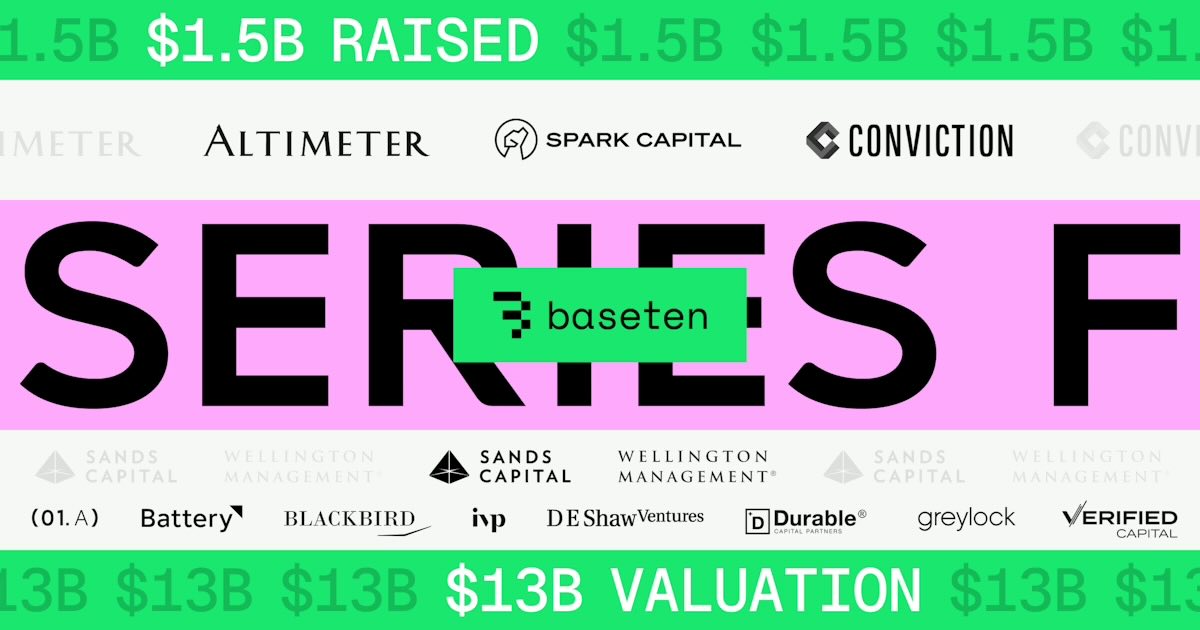
Today, Blackbird deepens our partnership with Baseten in their $1.5 billion Series F. The round is led by Altimeter Capital, Conviction, and Spark Capital, with participation from Sands Capital, Wellington Management, IVP, T. Rowe Price, Durable, and 01A.
Who is Baseten?
When a doctor uses Abridge, they expect an answer in milliseconds. When a developer uses Cursor, they expect code before their fingers leave the keyboard. When a lawyer uses Harvey, they expect the draft to be right the first time.
Behind all of that is inference, which is the process of running a trained AI model to generate a result.
At small scale, inference is easy. At the scale Baseten operates, more than a billion calls a day, it becomes one of the hardest distributed systems problems in software.
The right hardware, the right models, queries routed across multiple clouds without the user noticing. Baseten does all three.
Their Multi-Cloud Management pools GPU capacity from every major provider into a single reservoir. When the major clouds went down last year, Baseten's customers stayed online. The platform routed workloads to wherever the compute was live. No one noticed.
Cursor, Abridge, OpenEvidence, Harvey, Clay, Notion, Lovable, Decagon. They build great AI products. Baseten makes sure those products actually work.
An inflection hiding in plain sight
Inference spend is projected to grow from $1.3 trillion to over $3 trillion by 2030. By the end of this year, inference will account for two-thirds of all AI compute.
The gap between frontier and open-source models has collapsed. Almost all economically valuable work can now be performed by open-source models.
Post-trained open-source models deliver frontier-level quality at 70 per cent lower cost. The most advanced AI application companies are already directing 30 to 50 per cent of their model spend to custom or open-source models. The market overall is at 5 per cent. The transition is inevitable as companies mature.
But something else shifted in the past six months. Something more important than cost.
Frontier labs started competing with their best customers.
OpenAI released a coding agent. Anthropic leaked an app builder. Both are targeting healthcare. The companies paying millions in API fees were now funding the development of their own competitors.
That creates a difficult question. How do you build a differentiated product when your model provider is also your competitor?
The best companies found their answer. They are building and owning their own models on their own data. Baseten is why that's possible at scale.
Intelligence and inference
When we invested in Baseten's Series E six months ago, we backed an inference platform. Since then, Baseten has become something more.
The Parsed team, three Australian mathematicians of rare calibre, is now fully integrated. They onboard customers with fine-tuned, proprietary models tailored to their specific domain. Most recently Harvey.
Then Baseten's RL-scaling tools allow those models to keep learning from production data. Automatically. Continuously. This is why inference spend will keep compounding.
Every inference call becomes a training signal. Every training signal improves the model. Every improvement deepens the relationship.
The companies building durable AI products aren't just running models. They are improving them on proprietary data, closing a loop between what the product does in production and what the model learns next.
Baseten is already building its closed-loop systems directly with customers. Customer stickiness compounds with every model iteration.
The infrastructure of the open source era
Baseten has grown revenue ~20x in the past year. The team is on a path to tripling in headcount. Net dollar retention is among the strongest we have seen in a decade of investing, beating annual estimates in a quarter.
That's what happens when a company becomes genuinely essential to its customers' products.
Every conversation in our diligence said the same thing. The best AI companies love working with Baseten because they are obsessed with their customers. That obsession is rare. It is also very hard to compete with.
The talent joining is a signal in itself. Sameer Paranjpye spent nine years as VP of Engineering at Databricks, joining when Databricks was smaller than Baseten is today. Ian Nowlands, formerly VP of Core Infrastructure at Datadog, has joined to lead compute operations.
Leaning into the opportunity
Six months ago we wrote that Baseten was building a foundational pillar of the new economy. That undersold it.
Model runtimes, multi-cloud management, dedicated inference, optimised model APIs, post-training, enabling neo-labs and self-serve RL via Loops: Tuhin and the team aren’t building one pillar but the entire structure. We believe Baseten will be the infrastructure the open-source era is built on.
This is Blackbird’s largest investment ever because the opportunity demands it.


More Stories